Templates
Section 16 · Lesson 5 · Level: intermediate · ~15 min · Prereq: Skills as operating rules
Why this matters
Every lesson here asks you to write one document: a rules file, an ADR, an SOP, a skill, a runbook, an eval set. Starting from a blank page is where the habit dies, so this page is the shelf of starting points: copy the file, keep the lines that matter, delete the sample.
Each template fits a small project: one repository, one or two agents, one reviewer. Nothing here invents an action name, a CLI flag or a vendor feature — if a file needs more, read the linked lesson.
Where each file lives
Agents find files by convention and by path, so placement is part of the template: rules at the root, GitHub files under .github/, human documents under docs/.
flowchart TD
    R["repository root"] --> A["AGENTS.md"]
    R --> RD["README.md"]
    R --> S["skills/"]
    R --> D["docs/"]
    R --> G[".github/"]
    G --> W["workflows/ci.yml"]
    G --> P["pull_request_template.md"]
    G --> I["ISSUE_TEMPLATE/bug.yml"]
    G --> C["CODEOWNERS"]
    D --> DEC["decisions/"]
    D --> SOP["sops/"]
    D --> RUN["runbooks/"]
    D --> EV["evals/"]
    S --> K["db-migration/SKILL.md"]
    D --> LB["lessons.md"]
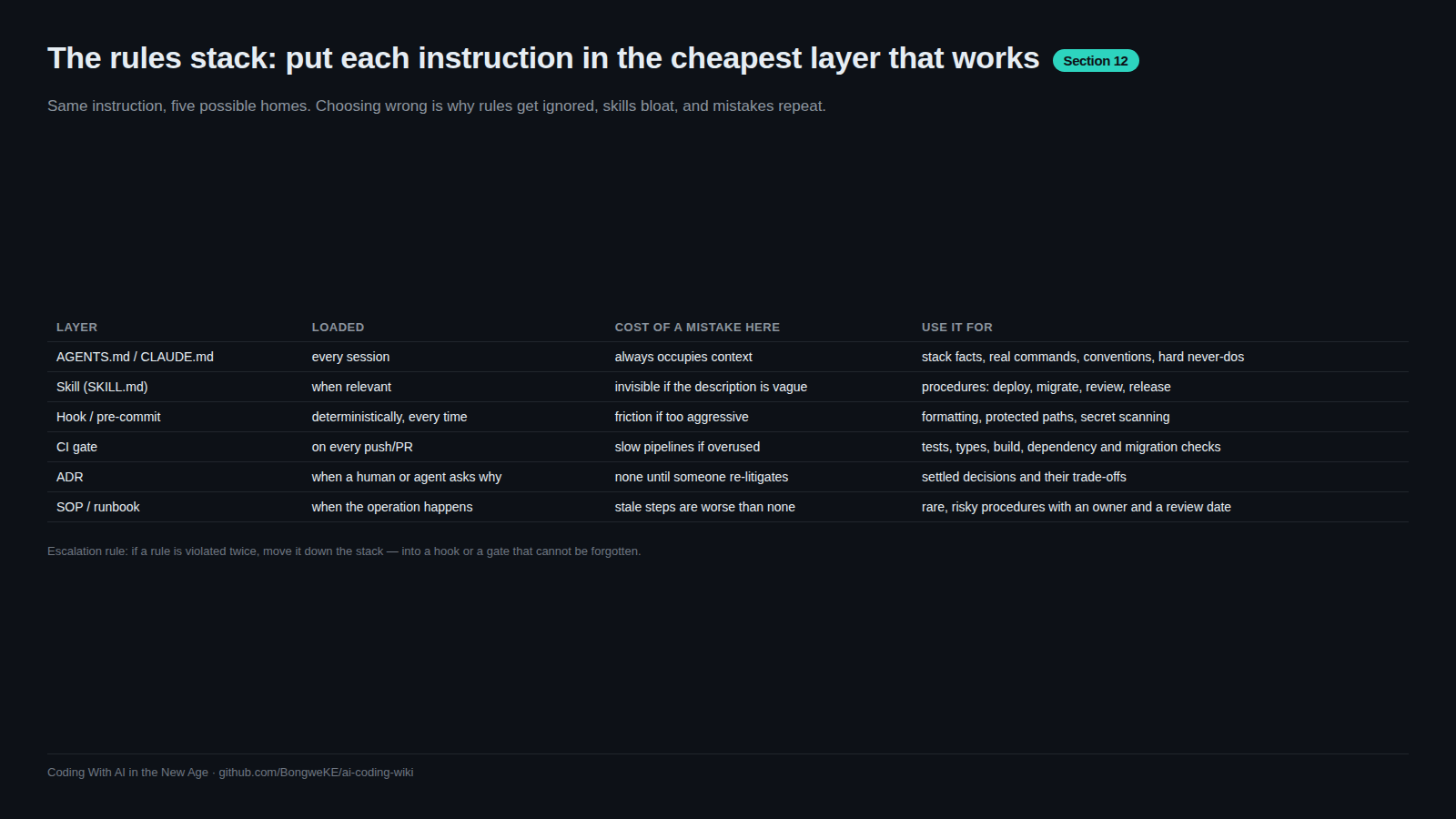
The rules stack these files form is worth seeing once before you write any of them:
1. AGENTS.md
The always-on file. Seven sections, under a page and a half.
# AGENTS.md

## Project
One line on what this is and what it is built with.

## Architecture map
- `src/` — application code
- `db/migrations/` — one numbered file per schema change
- `docs/decisions/` — read before proposing a design change

## Commands
- Test:    `pytest -q`
- Lint:    `ruff check .`
- Migrate: `python -m app.migrate`

## Conventions
- The wire format is camelCase; the database is snake_case. Do not "fix" it.

## Gotchas
- Placeholder order must match the values array, or the query returns zero rows. (2026-09-02)

## Definition of done
Tests pass, formatter clean, migration idempotent, changelog line added.

## Docs
- `docs/decisions/` — why the design is what it is
- `docs/sops/` — runbooks for deploys and restores
Keep: real commands, conventions that differ from language defaults, dated gotchas. Delete: anything the agent can derive from the code. See AGENTS.md that actually works.
2. ADR (MADR-shaped)
One numbered file per decision, next to the code.
# 0012 — Store uploads in object storage, not the database

- **Status**: accepted
- **Date**: 2026-10-07

## Context
Uploads are growing faster than the database's disk budget allows.

## Decision
Files go to object storage; the database keeps the key and the metadata.

## Options considered
1. Blobs in Postgres — rejected: backups grow without bound.
2. Object storage with keys in Postgres — chosen.

## Consequences
- Backups stay small and fast.
- Cost: one more service to configure in every environment.
Keep: rejected options and the stated cost. Delete: nothing real; never edit an accepted ADR — supersede it. See ADRs in practice.
3. SOP
For anything you do more than twice, or once if it is risky.
# SOP: Promote a release to production

- Owner: <name or role> · Review: 2027-01-07 · Tested on: 2026-10-07

## Trigger
A release is approved for production.

## Prerequisites
- The CI run for the release commit is green.
- Rollback point exists: tag `release-<previous>` and a Neon restore point.

## Steps
1. Run `pytest -q` on the release branch. Expect `N passed`.
2. Deploy the API. Expect `{"status":"ok"}` from `/health`.
3. Run migrations. Expect one `applied` line per pending file.

## Verification
The smoke test hits `/health` and one read endpoint, both green.

## Rollback
Redeploy `release-<previous>`, then confirm `/health`. Schema rollback: restore the
Neon restore point only if a migration changed data.

## Escalation
<name or role> — send what you ran and what you saw.
Keep: the rollback point and the expected output per step. Delete: any step you have not executed — mark it unverified. See Writing SOPs.
4. Pull request template
## What changed

## Why
Closes #

## How I verified it

```
$ pytest -q
12 passed
```

## Risk and rollback
Risk: <what breaks if this is wrong>. Rollback: <the reverse change>.

## Checklist
- [ ] Tests pass locally with the same commands CI runs
- [ ] No secrets, keys or customer data in the diff
- [ ] Rules file or ADR updated if this changes a decision
- [ ] Diagram updated if this changes a flow

<!-- Delete any prompt below that does not apply. -->
Keep: the verification block — a reviewer reads commands and output, not adjectives. Delete: checklist items your CI already enforces.
5. Issue forms
YAML forms under .github/ISSUE_TEMPLATE/, so a bug report arrives with the fields you need.
# .github/ISSUE_TEMPLATE/bug.yml
name: Bug report
description: Something is broken
title: "[bug]: "
labels: ["bug", "triage"]
body:
  - type: markdown
    attributes:
      value: "Do not paste secrets, tokens or customer data."
  - type: textarea
    id: what-happened
    attributes:
      label: What happened
      description: The exact command and the output you saw.
    validations:
      required: true
  - type: input
    id: version
    attributes:
      label: Version or commit
    validations:
      required: true
  - type: dropdown
    id: environment
    attributes:
      label: Environment
      options:
        - local
        - staging
        - production
    validations:
      required: true
  - type: checkboxes
    id: confirmed
    attributes:
      label: Before submitting
      options:
        - label: I ran `pytest -q` and pasted the failure
          required: true
The feature and task forms reuse that shape with different bodies:
feature.yml— onetextareafor the problem, one for the proposed behaviour, one for what is out of scope.task.yml— aninputfor the deliverable and adropdownfor size.
Keep: the secrets warning and the required fields. Delete: fields a reporter cannot answer — an abandoned form is worse than free text. See Issue-driven development.
6. CI workflow, Python and Node
Save as .github/workflows/ci.yml. Both versions use only actions/checkout, actions/setup-python or actions/setup-node, and actions/cache.
name: CI
on:
  pull_request:
    branches: [main]
permissions:
  contents: read
jobs:
  test:
    runs-on: ubuntu-latest
    timeout-minutes: 15
    steps:
      - uses: actions/checkout@v4
      - uses: actions/setup-python@v5
        with:
          python-version: "3.12"
      - uses: actions/cache@v4
        with:
          path: ~/.cache/pip
          key: pip-${{ runner.os }}-${{ hashFiles('requirements.txt') }}
      - run: pip install -r requirements.txt
      - run: ruff check .
      - run: pytest -q
name: CI
on:
  pull_request:
    branches: [main]
permissions:
  contents: read
jobs:
  test:
    runs-on: ubuntu-latest
    timeout-minutes: 15
    steps:
      - uses: actions/checkout@v4
      - uses: actions/setup-node@v4
        with:
          node-version: "20"
      - uses: actions/cache@v4
        with:
          path: ~/.npm
          key: npm-${{ runner.os }}-${{ hashFiles('package-lock.json') }}
      - run: npm ci
      - run: npm run lint
      - run: npm test
Keep: permissions: contents: read, the lockfile cache key, the real test command. Delete: || true, continue-on-error: true and unguarded pipes — each one makes the pipeline green forever. Baseline: Your first CI pipeline.
7. CODEOWNERS
# .github/CODEOWNERS — last matching pattern wins.

*                        @your-org/maintainers
/.github/workflows/      @your-org/platform
/docs/decisions/         @your-org/architects
/skills/                 @your-org/maintainers
Keep: the workflows path — CI is a credential surface. Delete: owners who have moved on. See Team ownership and CODEOWNERS.
8. SKILL.md
A skill is a folder with a SKILL.md whose frontmatter carries name and description. The description is what the agent sees before it decides to load the rest.
---
name: db-migration
description: Use when changing the database schema — naming, idempotency and the rollback step. Not for query tuning.
---

# Database migrations

## Steps
1. Add `db/migrations/NNNN-<slug>.sql`; never edit an applied file.
2. Run it twice locally and confirm the second run is a no-op.

## Rules
- Schema only. Data moves are a separate, reviewed change.

## Reference
- `reference/rollback.md` — read only when a migration must be reverted.
Keep: the trigger description and the pointer to a bundled file — that is progressive disclosure. Delete: anything the agent can read from the migrations directory. See Anatomy of a SKILL.md.
9. Lesson-bank entry
Append-only, dated, one to five lines. Written in the same commit that produced the lesson.
## 2026-10-07 — SQL placeholder order

The values array must match the positional placeholders in order; a mismatch
returns zero rows instead of raising. Confirmed by running the query with the
values reversed and seeing an empty result, not an error.

Fix: build the SQL text and the values list from the same source list.
Keep: the date, the observation, how it was confirmed. Delete: speculation — an unconfirmed theory gets quoted back as fact. See Lesson banks and retros.
10. Eval-set description
For any AI feature, write the set down before you tune the prompt.
# Eval: support reply drafts

- Feature: draft replies for support tickets
- Data: 40 anonymised tickets — 30 tuning, 10 held back
- Must-pass checks
  - No invented policy, price or delivery date
  - Cites the ticket's own reference number
- Scored by: human review on a 1–5 clarity rubric
- Pass bar: 90% of must-pass checks, and no drop on the held-back 10
- Run when: the system prompt, the model, or the retrieval config changes
Keep: the held-back set and the re-run trigger. Delete: metrics nobody looks at. See Evaluating AI features.
11. Runbook
Shorter and blunter than an SOP: one alert, the first thirty minutes, no history.
# Runbook: api_p95_latency above 2s for 5 minutes

1. Check whether a release went out in the last 30 minutes.
2. Check the database connection count against its limit.
3. If latency started at a release: roll back to `release-<previous>`.
4. If it started without a release: check the slow-query log for one new query.
5. Escalate to <name or role> with the last two commands you ran and their output.

Stop: do not raise limits to make an alert quiet. Find the change first.
Keep: the branches and the explicit stop line. Delete: diagnosis theory. See Rollbacks and incidents.
12. Security checklist
- [ ] No secret, key or token in the repo, the rules file or a test fixture
- [ ] Every new outbound call has a timeout and a failure path
- [ ] Input from a user, a webhook or a document is validated before it is trusted
- [ ] New dependencies exist in the registry and are pinned
- [ ] CI actions used by workflows are pinned to a commit SHA
- [ ] Logs contain no tokens, personal data or full request bodies
Keep: the items specific to how this project breaks. Delete: generic advice — a surviving checklist has a real incident behind each line. See Security checklists.
13. Release-notes entry
## 1.4.0 — 2026-10-07

### Added
- Retry with backoff on provider timeouts

### Fixed
- Duplicate notification when a callback arrived twice

### Security
- Pinned CI actions to commit SHAs

### Removed
- The unused `/v1/legacy` route
Keep: one line per user-visible change, same order every release. Delete: internal refactors and dependency bumps. See Versioning and release notes.
Try it
- Pick the two templates your project is missing most — usually
AGENTS.mdand the CI workflow. - Copy them, replace every sample with your own commands, then delete the lines that do not apply.
- Commit the files with the change that needed them, not as a separate "docs" pull request.
- Open a PR with the new template and confirm the checklist gets filled in.
- Next time something costs you ten minutes, add a lesson-bank entry and one gotcha line to
AGENTS.md.
Common mistakes
- Copying a template without deleting the sample content. A rules file that describes another project is worse than an empty one, because the agent believes it.
- A template nobody enforces. An unreviewed PR template is decoration; connect the requirement to a check or drop the line.
- Commands that are not the commands.
npm testwhen the script istest:unitteaches the agent to improvise. Copy the real command. - Frontmatter-free skills. A
SKILL.mdwithoutnameanddescriptionis invisible to the agent's skill discovery. || truein a CI template. It ships a pipeline that cannot fail, and the second copy spreads it.- A checklist that grows and is never pruned. Past about ten items people tick without reading, which is the same as no checklist.
Key takeaways
- Templates remove the blank page; their value is in the lines you delete after pasting.
- Rules at the root, GitHub files under
.github/, human documents underdocs/. - Annotate the two or three lines that carry the intent, and delete the sample content immediately.
- A template that is not enforced by a check or a reviewer is decoration.
- When a mistake happens twice, fix the template or the rules file rather than the code alone.
Further learning
- Rules of operation: the full stack — how rules, SOPs, ADRs and skills fit together.
- AGENTS.md that actually works — the seven sections and why the file must stay short.
- Equipping agents for the real world with Agent Skills — the
SKILL.mdformat and progressive disclosure. - Secure use reference for GitHub Actions — why
permissions:and SHA pinning are in the workflow templates above. - Definition of done — what the checklists are actually checking for.