Case Study: A Payments Platform
Section 14 · Lesson 1 · Level: advanced · ~25 min · Prereq: Environments and promotion
Why this matters
Every practice in this wiki was learned somewhere, at a cost. This section is the receipts: four real projects, anonymised, with the setup, what worked, and the mistakes that actually happened. The first is a Kenyan payments platform — the hard case, because the failure mode is somebody's money.
The setup
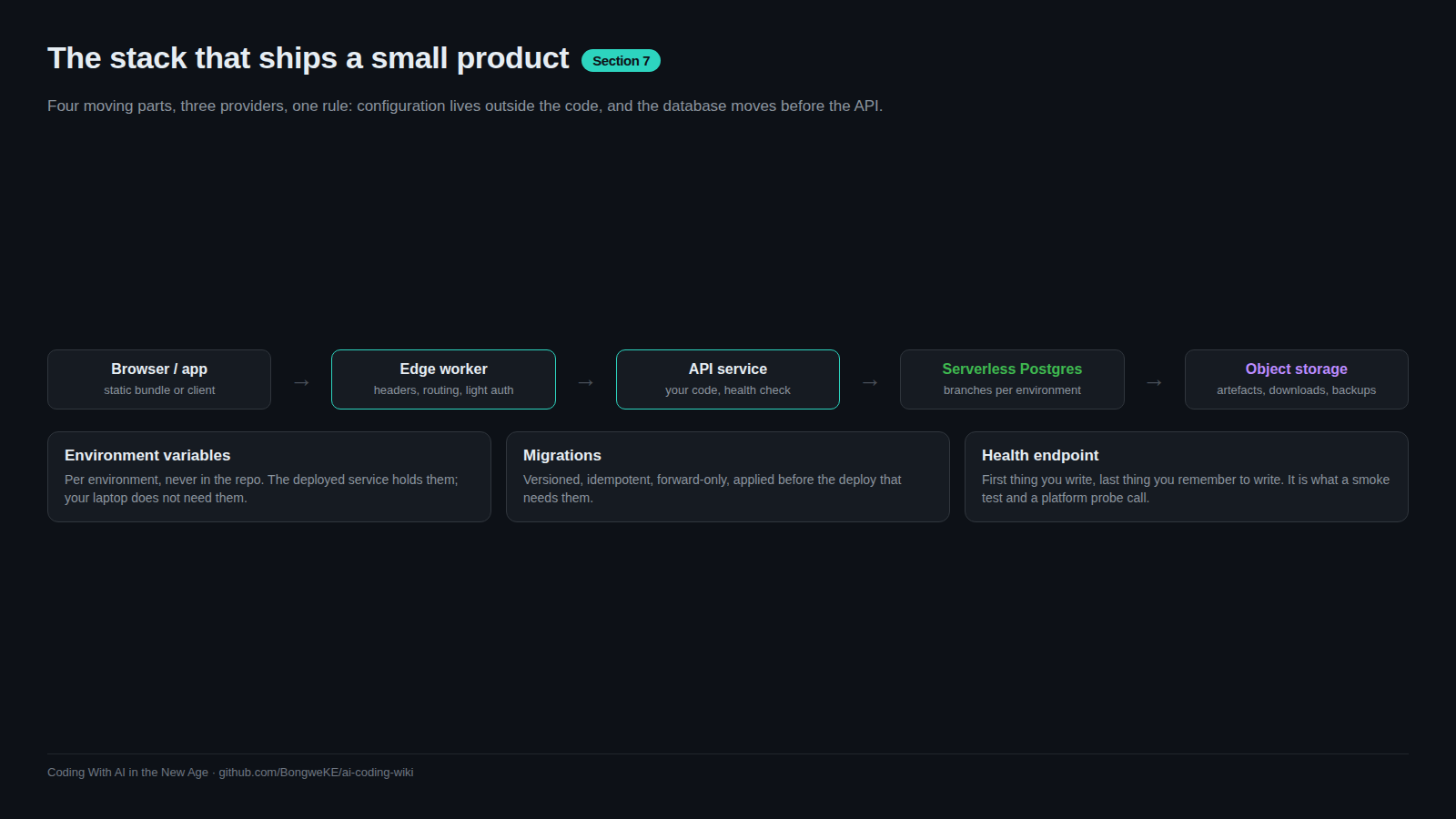
A mobile and web fintech product for merchants: one app, one dashboard, one language shared across app, API and models, all in a monorepo, moving money through a banking-as-a-service partner and mobile money rails. Two decisions set the tone on day one. Production deploys were gated behind a manual promotion, and staging ran against its own branch of serverless Postgres (branching gives you a separate copy of schema and data on its own compute — see Neon's docs).
flowchart LR
    A["Mobile app and web dashboard"] --> B["HTTP API"]
    B --> D["Serverless Postgres"]
    C["Background worker: polls and reconciles"] --> D["Serverless Postgres"]
    B --> E["Banking-as-a-service partner"]
    B --> F["SMS and email provider"]
    E -->|"signed callbacks"| B
    B -->|"server-sent events"| A
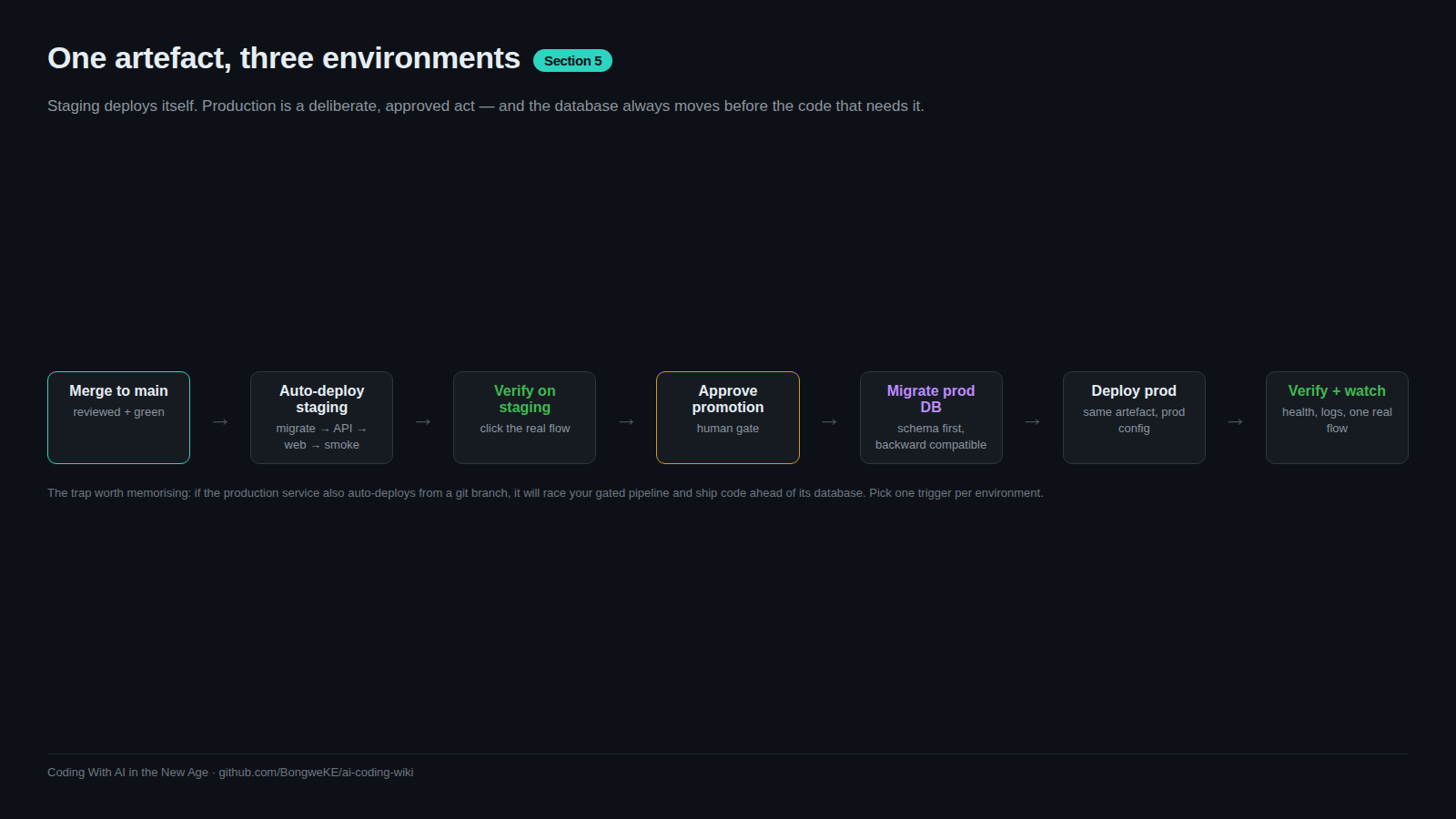
flowchart TD
A["Feature branch"] --> B["Pull request gates"]
B --> C["Merge to main"]
C --> D["Auto-deploy to staging"]
D --> E{"Exercised on staging?"}
E -- "no" --> A
E -- "yes" --> F["Manual promotion, reviewer approves"]
F --> G["Migrate the production database"]
G --> H["Deploy the API"]
H --> I["Deploy the web app"]
I --> J["Smoke test"]The pipeline above is the part worth copying.
What worked
Staging first, never production from a branch. Merging to main deployed staging automatically; production moved only through an explicit, human-approved dispatch.
One local gate script that mirrored CI. Every pull-request check existed as a single local command, so "green locally" meant "green on the PR". Two of them earned their place: a secret scanner over the commits a branch introduces, and a conventional-commit check on the PR title.
Decisions and docs per feature. Significant calls became short architecture decision records and every feature shipped with a doc update. The payoff came weeks later, when a rule like "never attach a git source to the production service" was already written down with its reason and date.
Migrations that were safe to re-run. Every migration used IF NOT EXISTS guards and no destructive statements, so running the migrate tool twice was boring — which is what you want from the step that touches production during a promotion.
What bit them
The wire contract drifted. The API serialised rows as snake_case; the app's models read camelCase. Nothing crashed: the client caught the deserialisation error and rendered its empty state, so a merchant saw "no wallet yet" while the API returned the wallet. Verify the contract against a live response before debugging the screen — one curl against staging settled an afternoon of guessing.
SQL placeholders silently mis-bound values. The helper numbered placeholders by their position in the SQL text, so WHERE a = $1 OR b = $1 became two parameters and a value passed once failed to bind. Worse, an UPDATE whose WHERE clause appeared after the SET values bound a later parameter, matched zero rows, and still reported success. Keep placeholders in the same order as the values array, and make the helper throw on a count mismatch.
A callback replied success while doing nothing. The upstream required the literal body ok, so the route returned it — and exceptions in the handler were swallowed. The event row recorded processed=true while the account row never changed. A success reply is a claim, not evidence. Make swallowed errors loud, and keep a status column you can query when the numbers look wrong.
TLS worked locally and failed in the container. The runtime image was a slim base with no certificate bundle, so outbound HTTPS calls died on verification — while the same code passed on the laptop, whose toolchain ships its own root store. Test the deployed artefact, not your machine. A ten-line probe compiled the way the image compiles it tells the two apart.
In-memory state broke with a second instance. Real-time updates used an in-process publish/subscribe bus; bank codes sat in a static cache. Both are correct with one replica and quietly wrong with two: an event published on instance A never reaches a client on instance B. Know where your state lives before you scale, and pick the swap (Postgres LISTEN/NOTIFY or Redis) while the call sites stay identical.
A production service auto-deployed from git and outran the gate. The production API still had a repository trigger, so every merge redeployed it before the gated migration and the web promotion. Three production layers ended up on different commits, the API ahead of its own schema. One deploy path per layer — Railway's CLI docs show the path that stays.
The retrospective format worth stealing
Their write-ups were framed as "how we would have gotten here faster", ordered by time lost rather than blame: the symptom, the diff that fixed it, and the gate that would have caught it. That framing is why the list above is reusable — see Lesson banks and retros.
Money raises the bar
Idempotency keys must be immutable: releasing a claim because an upstream call timed out can execute the same transfer twice, and a reused key with a different body must be rejected rather than re-executed. Every signature you compute must also be enforced, on inbound callbacks and on responses you trust. Reconciliation needs three legs, not two — your records, the partner's, and the settlement files — because two cannot detect a partner error. Audit logging, PII retention limits and incident-reporting windows are launch requirements. Privacy and compliance basics covers the shape.
Try it
- Open your CI workflow and list every check it runs. Find the local equivalent of each, and note the ones you cannot run locally — that is your next hour of work.
- Ask an agent: "list every place this service is configured to deploy, including platform dashboards and git integrations. Do not change anything." You are looking for two paths for one artefact.
- Grep for swallowed errors (
catch {},except: pass) and decide, for each hit, whether the caller then reports success. - Add one line to your lesson file: the symptom, the fix, and the gate that would have caught it.
Common mistakes
- Treating a 200 as proof of work — the handler returned the body the upstream demanded while the database wrote nothing. Assert on the effect, not the reply.
- Debugging the client before the contract — an empty screen is usually a naming mismatch.
curlthe live endpoint and read the raw keys first. - Two deploy paths for one service — a platform git integration redeploys your API ahead of the migration its schema needs. Keep exactly one path.
- Testing TLS on your laptop — the local toolchain carries its own trust store, so a passing check proves nothing about the container. Probe from inside the built image.
- Scaling without auditing in-memory state — in-process caches and event buses are invisible until they are wrong. Run two instances in staging once, on purpose.
Key takeaways
- Gate production behind a manual promotion, and keep staging isolated down to the database, not just the app.
- Field names, placeholders, dimensions and env vars are all contracts: verify them against the live system, never from memory.
- A swallowed exception plus a success reply is the most expensive bug shape in this list. Assert on effects.
- Test the artefact you deploy. Local success is evidence about your laptop.
- One deploy path per layer. Where money moves, idempotency, enforced signatures, three-way reconciliation and audit logging stop being optional.
- Probe the upstream API before you build around it: a documented endpoint name is not necessarily the one that works.
Further learning
- Neon docs — branching, serverless Postgres, and how a branch-per-environment database works.
- Railway CLI: deploying — the deploy path used inside a pipeline instead of a git trigger.
- GitHub Actions documentation — workflows, environment protection rules and manual dispatch.
- Secure use reference — what to lock down in your workflows, including secret scanning.